Recruiting
It's (almost) 2026 — why applications still feel like 1997
Why do applications in 2025 still feel like they did in the 1990s? We explain why static application forms fail — and how dynamic, AI-based applications do it better.
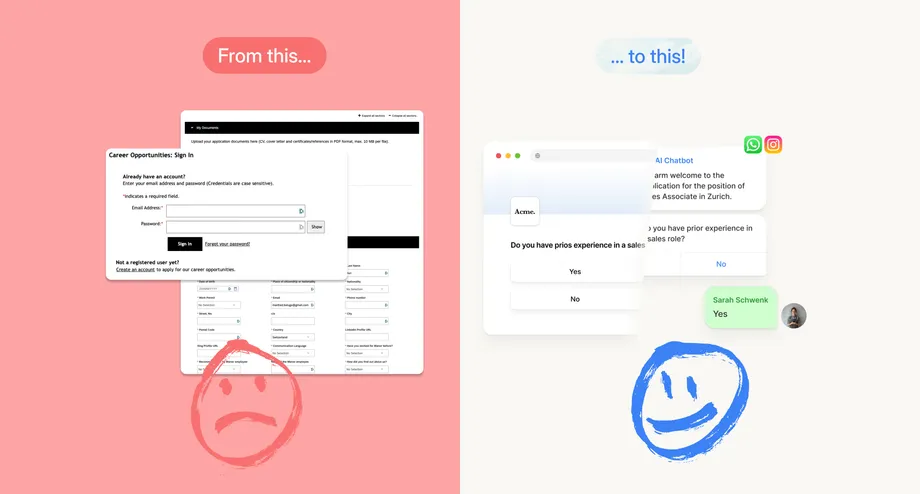
A few months ago at PastaHR, we launched dynamic job applications in the browser.
“But Patrick, it’s 2025”, you might ask. “Haven’t job applications been solved 20 years ago already?” Fair question. After all, Amazon introduced one-click checkout in 1997.
So why did we decide to still go after the “good” old application form? Well, applying to jobs today still feels like we’re stuck in 1990. All that really happened since, is that the physical letter application was turned into a static online form. This has to change.
1. Easy > Difficult
Sending a job application is the first touchpoint a potential hire has with their future employer. If applying is already a hassle, how will working at this company be?
Long story short: adding required logins (still the default for many systems), asking for countless documents and certificates, or forcing candidates to re-enter information that’s already in their CV leads to one thing: losing great talent that never ends up applying.
On top of that, around 80% of jobs worldwide are not for people who sit in front of a computer every day (like most of us here on LinkedIn). A polished CV, which most application processes are still built around, is often the wrong evaluation tool.
Additionally, the process must also work seamlessly on mobile and communication is key. Email might work well for white-collar roles, but what about mechanics, nurses, truck drivers, and other deskless talent?
2. Personalised > Standardised
Even if we assume that legacy application forms are reduced to a simple CV upload and are mobile-friendly, the process is still exactly the same for every applicant.
However, should applying for a software engineering role look the same as applying for a nursing position? Of course not. Application processes need to be optimised for the specific profile to get the best results.
3. Dynamic > Static
(Say hi to Agentic Workflows 👋)
At PastaHR, we believe that every application process is a conversation between applicant and company. This conversation starts with the application itself. But static application forms are about as far away from a real conversation as it gets.
AI finally allows us to change this. Depending on previous inputs, an applicant’s path can look very different. Maybe they’re asked whether they plan to move if their address is far away from the job location (very relevant if remote work isn’t an option). Or if it becomes clear that a role isn’t a fit (for example due to a missing permit), they can be dynamically matched to a different position instead.
At the same time AI doesn’t decide everything. Especially in enterprise environments (which we call our home), having clear boundaries is critical. That’s where PastaHR’s Agentic Workflows come in. By combining the best of AI with a deterministic workflow logic, PastaHR customers can define in detail which parts of an application should be AI-powered and which ones should not.
4. 💩 in 💩 out
Last but definitely not least, AI systems are only as good as the data you feed them. This is especially true in recruiting, where more and more systems rely on AI to screen or rank candidates (stay tuned here!).
One big problem we see is that most of these systems still only rely on CVs as their main input. But CVs have a fundamental flaw: you can’t control what’s written in them. Every CV looks different. That leads to unpredictable data, worse assessments and, inevitably, more bias.
Owning the application process – and being able to dynamically ask relevant questions during the application – helps close those information gaps. Instead of guessing, you get structured, comparable data.
To summarise:
Yes, even in 2025, most application processes suck, starting with the form.
That’s why we decided to rethink it. Applications must be easy, personalised, dynamic, and powered by AI.
Because without a dynamic and smart application, candidates suffer and the AI revolution already fails at the very first step.