- Security
How Securitas increases hiring rates through mobile-first contact
How Securitas AG uses mobile recruiting to cut time-to-hire by over a week and reduce response time to under 24 hours.

> 1 week
faster time-to-hire
< 24h
response time
40%
time saved per application
Securitas AG is exploring new avenues in talent acquisition: in an environment characterized by fast decision-making, the company relies on a low-threshold mobile application channel. This has increased efficiency and massively shortened the time-to-hire.
Talking to the experts
In this case study, we share exclusive insights into Securitas’ recruitment strategy. We spoke with Alexander Lampert and Karin Eggspühler from the Zurich Regional Directorate of Securitas AG. As Team Leader HR Management and Coordinator HR Management Recruitment, they are responsible for the entire recruitment process—from uniformed security services to office staff—as well as personnel marketing and employee support.
The starting point: “It’s hours that count, not days”
In the security market, reaction speed is a decisive factor. “Our applicants are often students who don’t want to wait for long response times.” With an original time-to-hire of around 34 days and a response time of about three business days, the process was often too slow for the target group. The goal was to radically simplify the initial contact.
The approach: Mobile-first for greater proximity
By integrating PastaHR into the existing applicant management system (rexx), a modern, mobile channel for initial contact was created. This allows for a more direct and contemporary approach:
- Initial response time: Reduced from 3 days to under 24 hours.
- Time-to-hire: Reduced by more than one week.
- Familiarity: The informal channel lowers barriers and fits the company’s established “Du” (informal) culture.
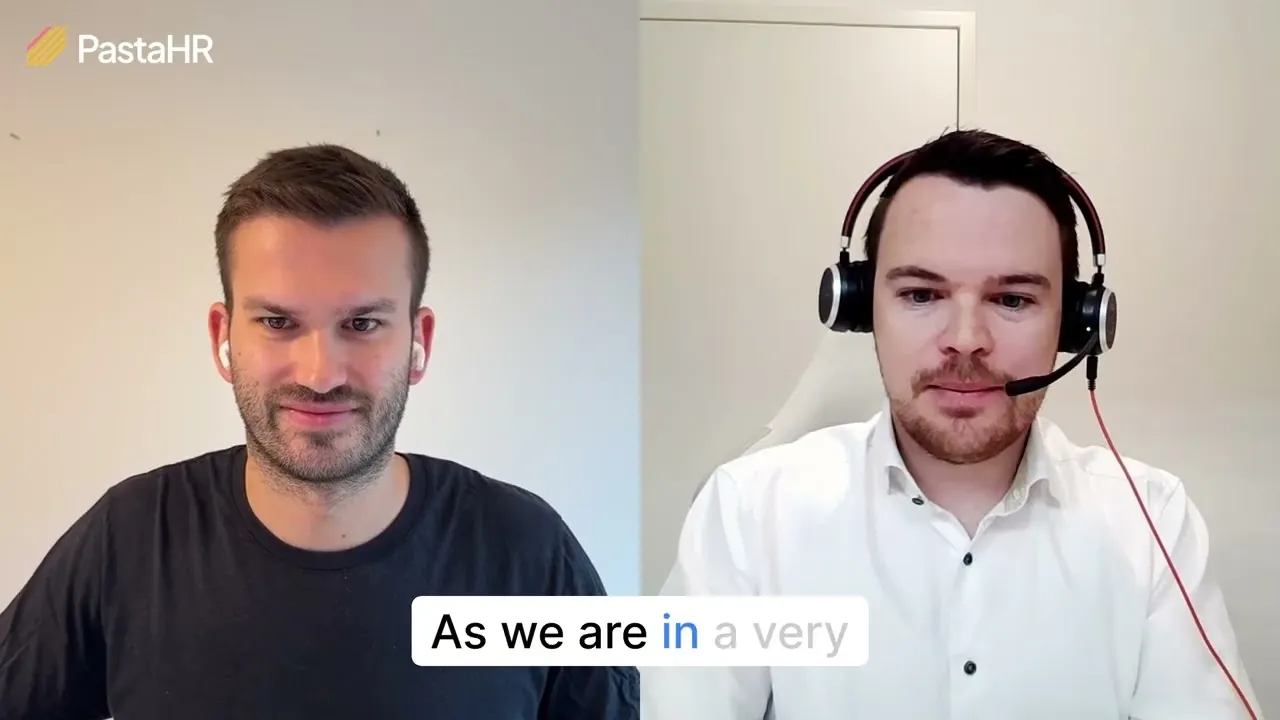
“It feels much less complicated to communicate via mobile channels than through the formal route via a recruitment tool or email. This supports our approach of creating greater proximity to employees right from the start of the recruiting process.”— Alexander Lampert, Team Leader HR Management Securitas Zurich.
The data proof: Disproportionate success rate
The evaluation for 2025 shows the significant impact of the mobile channel on the overall results of the Zurich Regional Directorate:
- Success record: Almost half (approx. 47%) of all annual hires are realized through PastaHR.
- Hiring rate: With a hiring rate of 5% of all applications, PastaHR is above the overall average of 4.3%.
Focus on soft skills: Time saved through smart screening
Automated pre-qualification checks necessary criteria directly during the application. This noticeably relieves the team:
- Approximately 3 minutes of time is saved per application during the initial screening.
- The leverage effect: What sounds like a small amount adds up to a massive time saving for the entire team given the high volume of applications via PastaHR.
- Strategic value: The team uses the time gained for personal marketing campaigns and more intensive employee support to sustainably reduce fluctuation.
Conclusion: Seamless system integration
A key factor for success was the technical integration. PastaHR is directly linked to rexx systems, allowing recruiters to continue working in their familiar environment while applicants benefit from the simplicity of a mobile process.
The result for Securitas: A lean process that meets the target group where they spend their digital everyday life—delivering measurably more success in hiring.
“Hours count, not days.”
— Alex Lampert, Teamleiter HR Management